

The missing link between form and function.
How the story connects design with leasing and management.

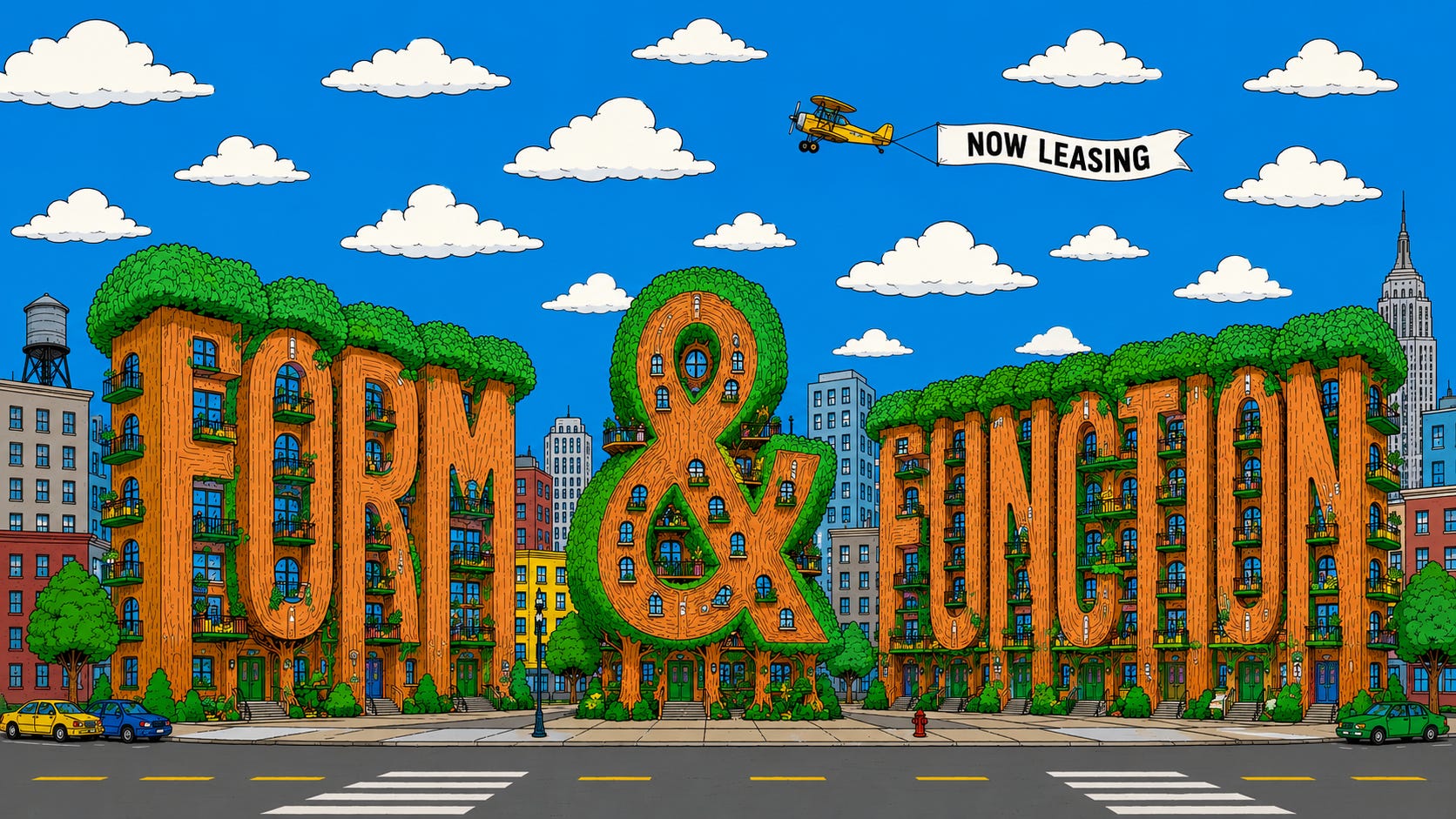
After financing, development competence, governance – and all of the insane complexity that comes with making a development happen – the success of a real estate project is contingent on two things:
Form and Function.
“Form” – how a project looks in real life and across all marketing channels; it’s aesthetic appeal to your audience.
“Function” – how a project works, based on a combination of design and operations.
While most projects strive for form and function, almost none have a clearly defined story holding them together.
So what you end up with is this:
Form is largely driven by taste and precedent, including what feels right, what’s worked before, what won awards last year…ultimately a ton of homogeneity.
Function is built on inherited assumptions. Unit mixes, amenity programs, staffing models – all shaped by outdated ideas around scale, behavior and how people actually use space…ultimately, places that leave customers unsatisfied with their experiences.
The missing piece in defining form and function is story.
As in: who this is for, what they’re dealing with and how this place actually changes something for them.
Story involves identifying an audience, their challenges and building distinct solutions to those challenges (what most people commonly refer to as a “value proposition”).
It also involves the creative communication of that value proposition through written and spoken language, design and elements of a human personality.
In the context of a physical space, story shows up through architecture, interiors, activations, service and events; through environment branding, sensorial elements, and even the way staff look. The story will quite literally empower the audience to reach some end, like a watering hole draws animals to drink.
The best projects use story as the starting point and the connective tissue for the entire development, from concept through eternity.
Form and function follow the story.
When a story is undefined or underdeveloped, gaps emerge between Architecture, Interiors, Brand, Retail, Leasing, Marketing, Management and Events.
Those gaps show up in the seams between disciplines. That’s where projects lose clarity, consistency and impact, and that’s exactly where alignment can bring everything together.
Here’s what that looks like in practice a subset of critical roles in CRE:
What breaks without a story:
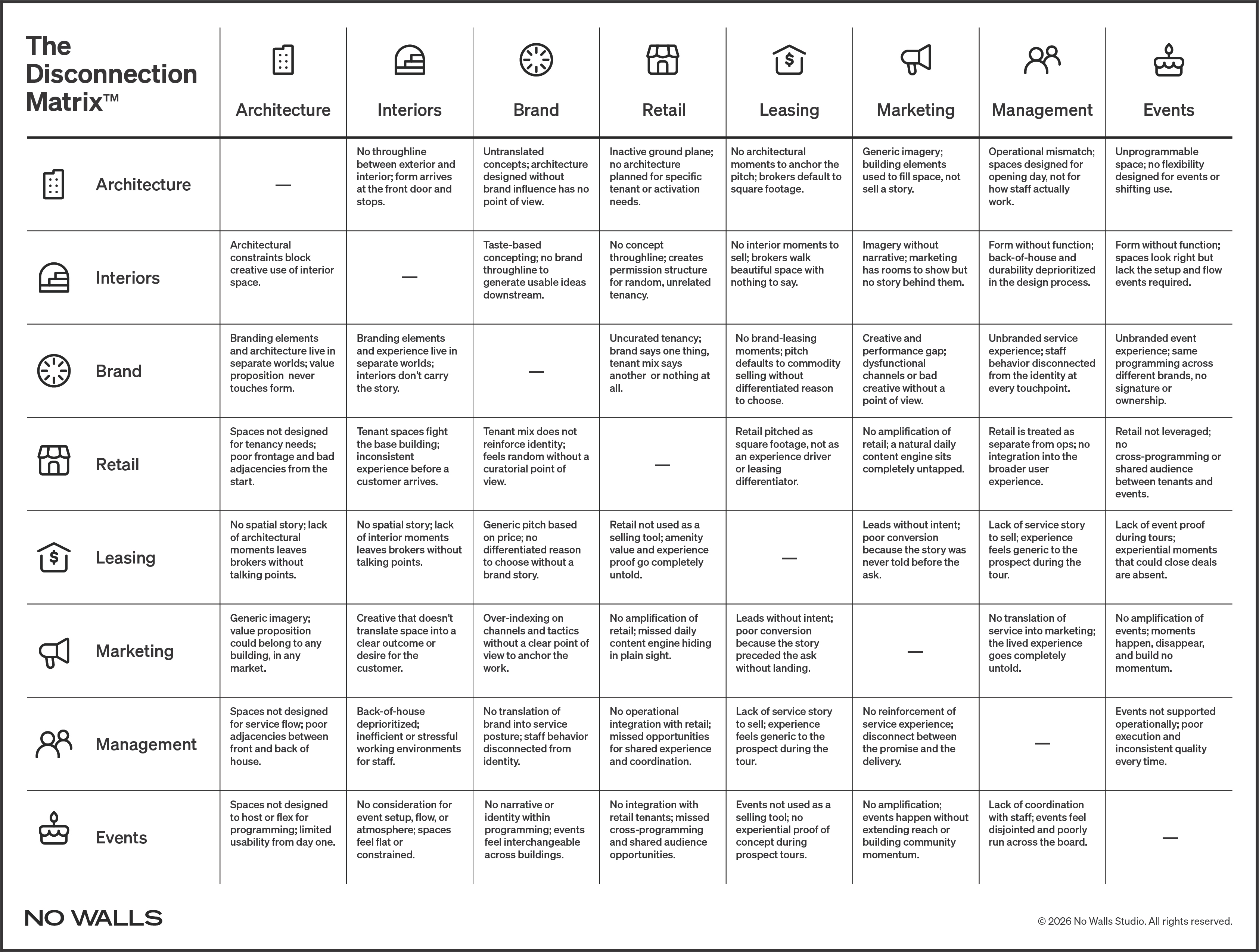

Every gap in this table is a version of the same problem: without a story, decisions are made in complete isolation.
With a story leading the way – when it’s specific, memorable, and distinct from everyone else’s story – the seams disappear.
WTF should this mean for you?
Write a good story before you start design. Make sure you have people who can carry that story through every aspect of your space.

Missed our last article? Read it now.

Missed our feature in The Brand Identity? Check it out now.



🚨 WHO IS NO WALLS STUDIO (AND WHAT DO WE DO)?
No Walls Studio is a design and brand consultancy that helps real estate developers create spaces that people love.
Our mission is to make sameness extinct in real estate, which means that everything we do comes with new ideas and unique angles — all, grounded in a deep understanding of culture and consumers.
We do three things for our clients (often, all in the same project):
Research & Insights
Brand Development
Spatial Design
Brand Activation
Want to work with us or learn more?

